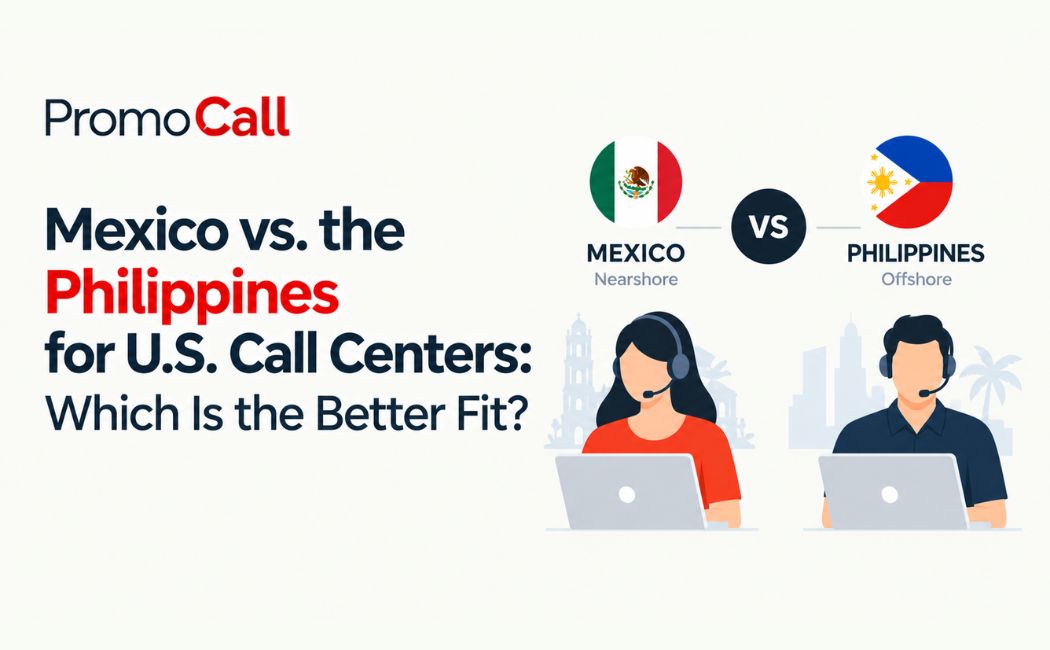
For most U.S. companies, the choice comes down to Mexico (nearshore) or the Philippines (offshore). Mexico usually fits better when you need real-time overlap with U.S. hours, Spanish-language support, and easy oversight. The Philippines can fit when you want a very large English-speaking talent pool and can manage a large time difference. Neither is the right answer for every business, so this guide compares them on the points that matter.
The Short Answer
| Factor | Mexico (Nearshore) | Philippines (Offshore) |
|---|---|---|
| Time zone vs. U.S. | Same or within 1 to 3 hours | Roughly 12 to 15 hours ahead |
| Business-hours coverage | Overlaps U.S. day shifts naturally | U.S. daytime calls fall in the Philippine night |
| Languages | English and Spanish | Strong English; limited Spanish |
| Travel for leadership | Short flight or drive | Long international trip |
| Typical cost | Lower than U.S., usually higher than the Philippines | Often lowest sticker price |
| Cultural alignment | Close to U.S. consumers, especially in the Southwest | Strong exposure to U.S. media and English |
| Best fit | Real-time support, bilingual, regulated work | Large English-only volume, overnight coverage |
Costs vary widely by role, volume, and provider, so get quotes for your own scenario instead of relying on averages.
1. Time Zone: The Biggest Practical Difference
A team in Mexico works your hours. A morning call from a customer in Texas or California is answered at the same time of day by an agent in Tijuana, and your managers can listen in, coach, and fix problems in real time.
With the Philippines, your daytime is their night. That’s useful if you need overnight coverage because your agents work their normal day while your customers sleep. But it makes live coaching and fast escalations harder, and many teams end up with a night-shift workforce and extra management layers.
2. Language and Culture
Both countries have strong English speakers, and the Philippines is well known for its English-language BPO industry. Mexico’s edge is bilingual capability: English and Spanish on the same team. If you serve U.S. Hispanic customers, that matters. A single Mexican team can switch languages on one call, instead of running a separate Spanish-language operation somewhere else.
For cultural fit, Mexico’s proximity means many agents have lived, studied, or worked near the U.S. border, which helps with tone and everyday references. Filipino agents are also widely trained on American accents and customer expectations. The more useful question is how well each provider trains, screens, and coaches its agents.
3. Cost: Look at Total Cost, Not Just the Hourly Rate
The Philippines is often cheaper per hour. But the cheapest rate isn’t always the lowest total cost. Consider:
- Night-shift premiums and management overhead for overnight teams
- Travel costs and time for site visits
- Rework and escalations when problems take longer to resolve
- Turnover that varies by location, provider, and shift
Mexico typically costs well under U.S.-based staffing, often by half or more, while keeping you inside U.S. business hours. For a full breakdown, see our guide to nearshore call center pricing in Mexico.
4. Compliance and Oversight
Healthcare, financial services, and insurance usually need close oversight, call monitoring, and clear data-handling controls. Being in the same time zone makes audits, live monitoring, and incident response easier. Whichever country you choose, ask any vendor for evidence of its security controls and audits, not just a promise. Our guide to SOC 2, PCI, and HIPAA compliance explains what to ask for.
5. Which Location Fits Your Business?
Mexico is usually the better fit if you:
- Need support during U.S. business hours
- Serve Spanish- and English-speaking customers
- Want to visit the team easily and manage it closely
- Work in healthcare, finance, insurance, automotive, ecommerce, or home services
The Philippines may be the better fit if you:
- Need large-scale, English-only support
- Need true overnight or follow-the-sun coverage
- Can manage a large time difference and a separate management structure
Some companies use both: a nearshore team for day-to-day, real-time support and an offshore team for overnight overflow.
How to Decide in Four Steps
- List your hours of coverage. When do customers actually call?
- List your languages. Do you need Spanish now or later?
- Rate your oversight needs. How much live coaching and compliance monitoring do you require?
- Compare total cost. Include management time, travel, and quality, not just the hourly rate.
For a broader look at all three models, read our guide on nearshore vs. offshore call centers, or start with what a nearshore call center is.
Frequently Asked Questions
Is Mexico cheaper than the Philippines for call centers?
Usually not on hourly rate alone, since the Philippines is often lower. But Mexico can win on total cost once you factor in management overhead, travel, and quality issues tied to a large time difference.
Do Philippine call centers speak better English?
Both countries have strong English speakers. Quality depends on the provider’s recruiting, testing, and training more than the country.
Which is better for Spanish-speaking customers?
Mexico, because bilingual English-Spanish agents are widely available.
Can I use both locations?
Yes. Some companies run a nearshore team for daytime support and an offshore team for overnight coverage.
Why do U.S. companies choose Tijuana?
It’s close to San Diego, shares the Pacific time zone, and has a deep bilingual workforce. See our Tijuana BPO page for details.
Compare Locations With a Real Quote
If you’re choosing between Mexico and the Philippines, PromoCall can walk you through realistic costs and timelines for a nearshore team in Tijuana. Schedule a strategy call.