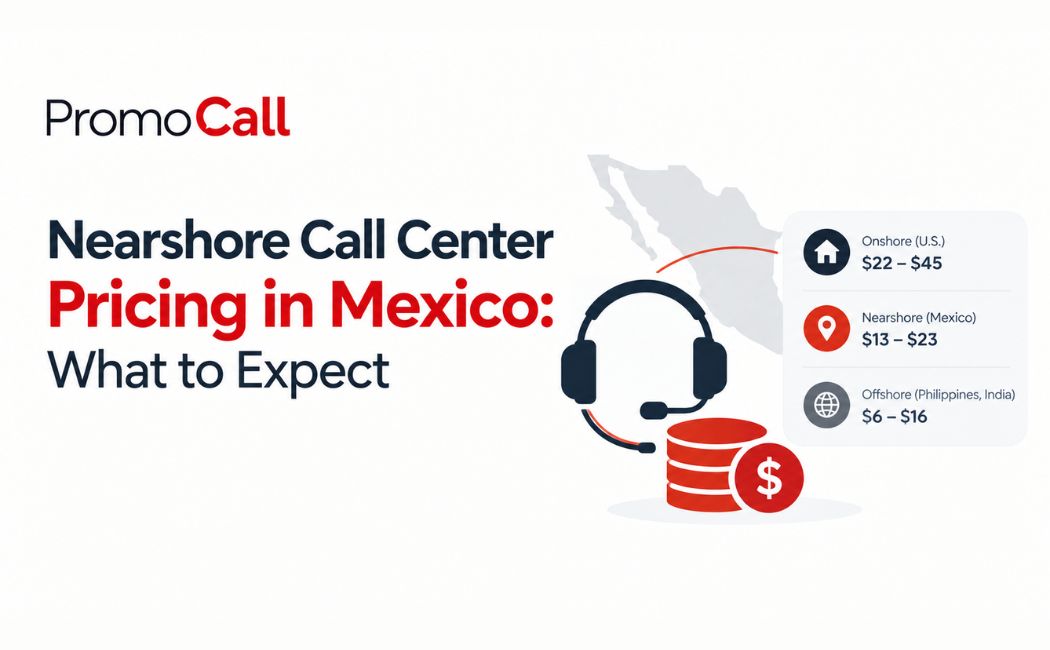
Published industry benchmarks put fully loaded nearshore call center rates in Mexico at roughly $13–$23 per agent hour, compared with about $22–$45 for a comparable U.S. onshore agent. “Fully loaded” means the rate already includes wages, payroll taxes, facilities, technology, supervision, and the provider’s margin, so it’s the number to compare, not raw wages.
If you’re budgeting for a nearshore team, pricing is often the first question and the hardest one to get a straight answer to. Quotes vary widely, and two proposals that look similar can hide very different costs. This guide explains what drives the price, how providers structure it, and what to ask before you sign.
Typical Cost Ranges by Delivery Model
| Delivery Model | Typical Fully Loaded Rate (per agent hour) | Time Zone Overlap with the U.S. |
|---|---|---|
| Onshore (U.S.) | About $22–$45 | Full |
| Nearshore (Mexico) | About $13–$23 | Full or near-full |
| Offshore (Philippines, India) | About $6–$16 | Minimal |
These are published industry ranges, not PromoCall quotes. Actual pricing depends on the factors below.
Based on these ranges, nearshore typically lands about halfway between onshore and offshore. Independent analyses generally put nearshore savings at around 40–55% against a fully loaded U.S. baseline, with some setups going higher depending on the role and what you compare against. The savings are real, but they are planning benchmarks, not guarantees.
What Drives the Price
Location within Mexico. Border cities like Tijuana, and large hubs like Mexico City and Guadalajara, price differently based on local talent supply and demand.
Language requirements. Fully bilingual agents with near-native English cost more than basic bilingual support, but they usually pay back in fewer escalations and higher satisfaction.
Role complexity. Technical support and sales roles cost more than basic order or appointment handling.
Compliance needs. PCI-, HIPAA-, or SOC2-aligned operations require more infrastructure, training, and auditing, which affects the rate. See our breakdown of SOC2, PCI & HIPAA compliance for what those requirements involve.
Team size and contract term. Larger, longer commitments generally earn better rates than small or short-term ones.
Agent attrition. High turnover is a hidden tax. Every departure means recruiting and training time before a replacement is productive, and the cost shows up in your results even if not on the invoice.
Common Pricing Models
| Model | How It Works | Best For |
|---|---|---|
| Per agent, per hour | You pay a fixed hourly rate for each dedicated agent | Predictable volume, dedicated teams |
| Per seat (seat leasing) | You lease workstations and infrastructure and manage your own team | Companies wanting more direct control (see our Seat Leasing service) |
| Per call or per transaction | You pay based on volume handled | Variable or seasonal volume |
| Blended/hybrid | A base team plus variable capacity for spikes | Businesses with seasonal peaks |
Costs to Ask About Before You Sign
- Setup and onboarding fees. Are recruiting, training, and system integration included or billed separately?
- Technology and licensing. Is telephony, CRM access, and reporting included in the rate?
- Management overhead. What supervision ratio is built in?
- Volume changes. What happens to your rate if you scale up or down mid-contract?
- Compliance costs. Are certifications and audits covered, or passed through?
Nearshore vs. Cheaper Offshore: Reading the Math Honestly
Offshore rates can look lower on paper, but the comparison should include time-zone friction, oversight effort, and quality outcomes. For a broader look, see our nearshore vs. offshore comparison and our guide to the true cost of in-house vs. outsourced call centers.
Frequently Asked Questions
How much does it cost to outsource a call center to Mexico?
Published benchmarks put fully loaded rates at roughly $13–$23 per agent hour, with the exact figure depending on location, language skill, role complexity, compliance requirements, and volume.
Why do quotes from different providers vary so much?
Providers include different things in the base rate. One may bundle technology, training, and management while another bills them separately, so always compare fully loaded totals rather than headline hourly rates.
Is nearshore always cheaper than in-house?
For most customer service and sales roles it is, often by around half. Very small teams or highly specialized roles can change the math, so it’s worth modeling your specific case.
What does “fully loaded” mean?
It means the hourly rate covers everything needed to run the seat: wages, payroll taxes, facilities, technology, supervision, and provider margin, not just what the agent earns.
Get a Quote Based on Your Actual Needs
Every setup is different. Tell us your volume, channels, and compliance requirements, and we’ll walk you through realistic pricing for your situation.