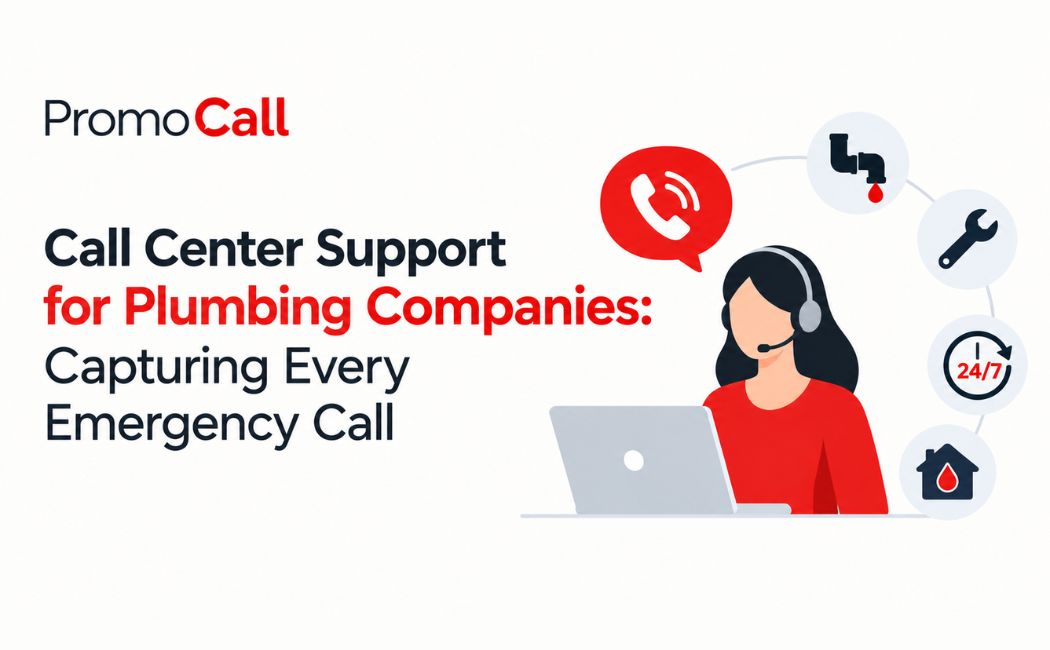
A burst pipe doesn’t wait for business hours, and neither do the customers calling about one — plumbing companies that can’t answer every call, especially nights and weekends, are handing emergency jobs directly to whichever competitor picks up first. Dedicated call center support closes that gap without requiring an in-house team to staff around the clock.
Plumbing is one of the most urgency-driven home service trades. A clogged drain can wait a day; a burst pipe, a sewage backup, or a flooded water heater cannot. Customers in these moments call the first plumber who answers, not the one they were planning to call next week.
Where Plumbing Companies Lose Calls — and Jobs
| Scenario | What Happens Without Coverage | How Call Center Support Helps |
|---|---|---|
| After-hours emergencies | Call goes to voicemail, customer calls the next plumber on the list | 24/7 live answering with emergency triage |
| Peak-hour overload | Office staff juggling calls while technicians are in the field | Overflow coverage absorbs extra volume without dropped calls |
| Routine scheduling | Low-urgency but still revenue-generating calls get deprioritized | Appointments booked directly into your scheduling system |
| Seasonal spikes | Freeze events or extreme weather create sudden volume surges | Scalable staffing flexes up temporarily without new hires |
| Follow-up and reminders | No time for proactive outreach | Automated reminders and maintenance follow-ups |
Emergency Calls Are Where the Real Risk Is
Unlike many home service trades, plumbing emergencies often involve active property damage — water doesn’t pause while a customer waits on hold. A trained answering team can triage urgency immediately: is this a true emergency requiring dispatch tonight, or a routine issue that can be scheduled normally? Getting this right both protects customers from unnecessary damage and protects your technicians’ time from being pulled onto lower-priority calls.
Capturing Routine Bookings, Not Just Emergencies
Not every plumbing call is a crisis — water heater replacements, fixture installations, and routine maintenance calls are steady revenue that still require someone to pick up the phone promptly. When office staff are stretched between answering calls and supporting technicians in the field, these lower-urgency (but still valuable) calls are often the first to slip.
24/7 Coverage Without 24/7 Payroll
Staffing an in-house team around the clock is expensive and operationally difficult for most plumbing businesses, particularly smaller or regionally focused ones. A nearshore call center partner provides scalable, round-the-clock answering and dispatch support without the overhead of hiring, training, and scheduling overnight staff directly.
Managing Seasonal and Weather-Driven Spikes
Freeze events, major storms, and seasonal temperature swings create sudden, sharp spikes in plumbing call volume — burst pipes and water heater failures cluster heavily around these events. A scalable call center partner can absorb these spikes temporarily, rather than leaving your office overwhelmed during the exact moments when fast response matters most.
Security and Trust for In-Home Service Businesses
Plumbing companies often handle payment information and scheduling data for in-home visits, where trust matters as much as technical skill. A call center operating under SOC2 and PCI compliance standards protects customer payment data as digital scheduling and payments become standard. See our SOC2, PCI & HIPAA compliance breakdown for details.
Frequently Asked Questions
Can a call center actually determine if a plumbing call is a true emergency?
Yes — agents can be trained on your specific triage criteria (active flooding vs. a slow drain, for example) to correctly route urgent calls for immediate dispatch while scheduling routine issues normally.
Will customers know they’re talking to an outsourced call center instead of our office?
Not when agents are trained on your business specifically — your scripts, service area, and scheduling system — so the experience feels like talking directly to your own office.
Is 24/7 coverage realistic for a smaller, local plumbing company?
Yes — this is actually where outsourced coverage helps the most, since smaller companies usually can’t justify staffing an overnight team in-house, but still lose real revenue to missed after-hours emergency calls.
Stop Losing Emergency Calls to Competitors
Every missed call is a job that goes to whichever plumber answers first. See our full Home Services industry support for more on how PromoCall supports trades businesses.