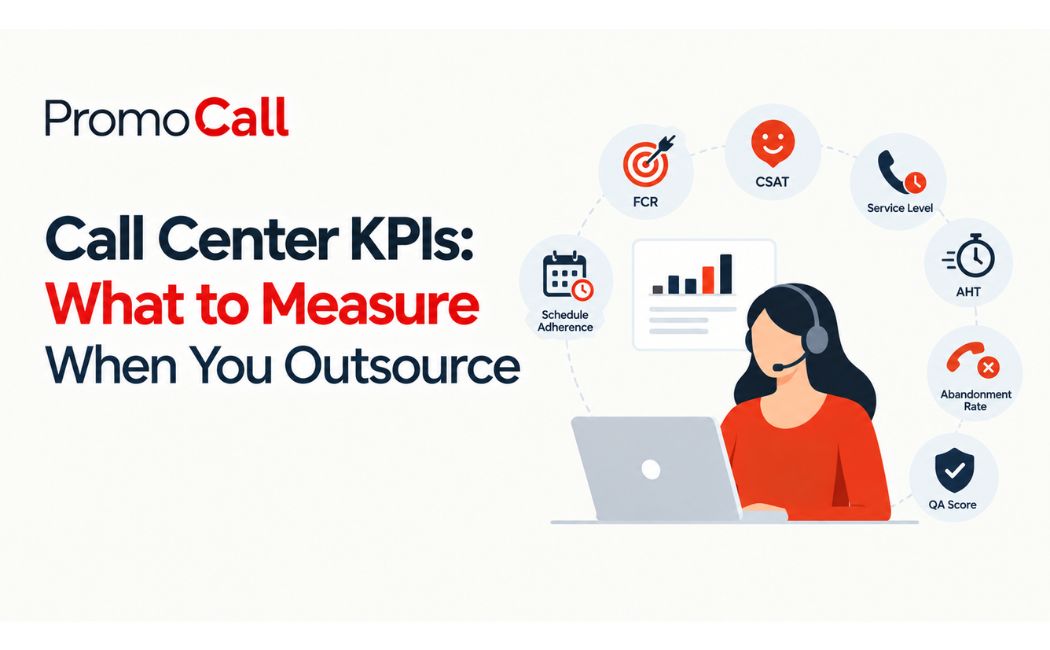
The call center KPIs that matter most when you outsource are first contact resolution (FCR), customer satisfaction (CSAT), service level, average handle time (AHT), abandonment rate, and quality assurance (QA) score. No single number tells you whether a provider is doing well, so a good scorecard balances speed, quality, and customer outcomes, and it’s agreed in writing before launch.
Outsourcing doesn’t mean giving up visibility. The best partnerships run on a shared scorecard that both sides review regularly. Here’s what to track and what each metric tells you.
The Core KPI Scorecard
| KPI | What It Measures | Why It Matters |
|---|---|---|
| First contact resolution (FCR) | Share of issues solved on the first interaction | Strongest signal of agent skill and process quality; repeat contacts cost money and patience |
| Customer satisfaction (CSAT) | Post-interaction customer rating | Direct read on how customers feel about the experience |
| Service level | Share of calls answered within a target time | Shows whether you have enough capacity at the right times |
| Average handle time (AHT) | Average length of an interaction | Useful for staffing, but dangerous as a standalone target |
| Abandonment rate | Share of callers who hang up before reaching an agent | A leading indicator of lost sales and frustrated customers |
| QA score | Rating of calls against your quality standards | Checks that scripts, compliance, and tone are being followed |
| Schedule adherence | How closely agents follow their assigned schedules | Affects whether service level targets can actually be hit |
First Contact Resolution: Your Quality Anchor
FCR tells you whether customers get their problem solved without calling back. A provider can look efficient on speed while pushing customers into repeat calls, and FCR exposes that. Define how you’ll measure it up front (for example, no repeat contact on the same issue within a set number of days), since the definition changes the number.
CSAT: Ask the Customer
CSAT is usually a short post-contact survey. It captures what internal metrics can’t: whether the customer felt heard. Agree on the survey method, the sample size, and who sees raw results. Pair it with call reviews so you understand the reasons behind the scores.
Service Level and Abandonment: Capacity Check
Service level is commonly expressed as a target such as answering a given percentage of calls within a set number of seconds. The specific target is a business decision, so choose one that fits your customers’ expectations and your budget, then track abandonment alongside it. High abandonment during peak hours usually means staffing doesn’t match your call pattern.
AHT: Use Carefully
Average handle time helps with staffing forecasts, but pushing it down too hard rewards rushing. Agents rush callers off the phone and FCR and CSAT suffer. Treat AHT as an informational metric, and watch it next to FCR and CSAT instead of setting an aggressive target in isolation.
QA Scores and Compliance
Quality assurance means scoring a sample of calls against a rubric: greeting, accuracy, empathy, process adherence, and compliance steps where regulations apply. Ask how many calls are reviewed, who reviews them, and whether you get access to recordings. For regulated work, QA is also your evidence that required disclosures and security steps are happening. See our SOC2, PCI & HIPAA compliance overview for what to verify on the security side.
How to Set Targets That Hold Up
- Baseline first. Measure your current performance before setting outsourced targets.
- Agree on definitions in the contract. “Resolved” and “answered in time” should mean the same thing to both sides.
- Set a ramp period. New teams need weeks to reach steady performance, so targets should step up gradually.
- Balance speed and quality. Pair every efficiency metric with an outcome metric.
- Review on a schedule. Weekly operational check-ins and a monthly business review keep problems small.
What Good Reporting Looks Like
You should get a dashboard or regular report covering the scorecard above, broken down by channel and time of day, with commentary on trends instead of raw numbers alone. If a provider can’t describe their reporting clearly before you sign, that’s a warning sign. Our buyer’s checklist for choosing a nearshore partner covers reporting and the other questions worth asking, and our pricing guide explains what should be included in the rate.
Frequently Asked Questions
What is the single most important call center KPI?
There isn’t one. First contact resolution and CSAT are the best indicators of customer outcomes, but they should be read together with service level and QA scores.
What’s a good first contact resolution rate?
It varies a lot by industry and call complexity, so compare against your own baseline and your sector, not a universal number. A rising FCR with stable CSAT is the pattern to look for.
Should I tie provider pricing to KPIs?
Many companies include performance targets and review mechanisms in the contract. Whether to add financial incentives or penalties depends on your risk appetite; keep definitions precise so disputes don’t arise.
How often should I review performance with an outsourced team?
Weekly operational reviews and a monthly business review work well for most teams, with closer attention during the first 90 days.