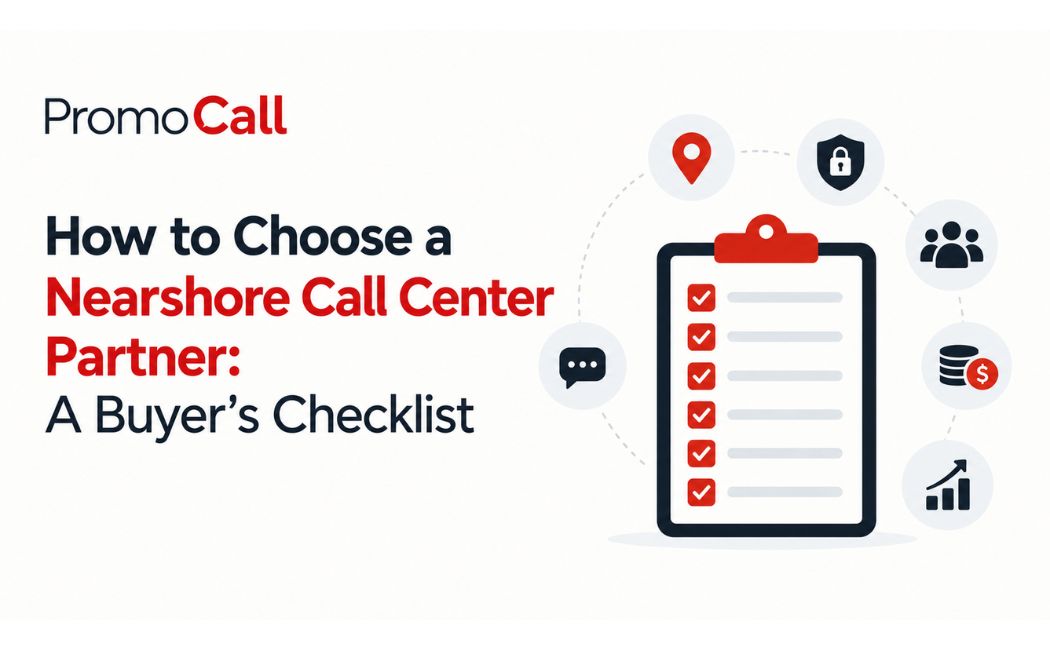
Choosing a nearshore call center partner comes down to evaluating six things: location and time zone fit, talent quality, compliance and security, pricing transparency, scalability, and communication/reporting — in that order of how hard they are to fix after you’ve signed a contract. Getting location and compliance wrong is expensive to reverse; getting reporting cadence wrong is just annoying. This guide walks through what to actually check before committing.
Nearshore outsourcing has become a default consideration for U.S. companies trying to control support costs without losing quality — but not all providers deliver on that promise equally. The difference between a strong partner and a disappointing one usually isn’t visible in a sales pitch. It shows up three months in, once the honeymoon period ends.
The Evaluation Checklist at a Glance
| Category | What to Check | Why It’s Hard to Fix Later |
|---|---|---|
| Location & time zone | Real facility location, actual overlap hours with your business | Changing providers over this is a full re-migration |
| Compliance & security | Current SOC2/PCI/HIPAA documentation, not just badges | Data exposure risk compounds the longer it goes unnoticed |
| Talent quality | Bilingual depth, training process, agent retention rates | Rebuilding a trained team elsewhere costs months |
| Pricing structure | What’s included in the “fully loaded” rate | Hidden fees surface gradually, not all at once |
| Scalability | How staffing flexes up/down, contract terms around volume changes | Rigid contracts are painful to renegotiate mid-term |
| Reporting & communication | What visibility you actually get, how often | Easiest to fix, but costly to ignore day-to-day |
1. Location and Time Zone Fit
Where a provider is actually located — not where their sales team is based — determines your real-time collaboration quality. A facility with full or near-full overlap with your business hours allows live escalation and management oversight; a facility with minimal overlap means next-day problem-solving becomes the norm. Ask directly: where is the physical facility, and can you visit it?
2. Compliance and Security
If your business handles payment data, health information, or other sensitive customer information, this isn’t optional. Ask for current SOC2, PCI, or HIPAA documentation with real dates, not a badge on a marketing page. See our breakdown of SOC2, PCI & HIPAA compliance for what these actually verify, and what to ask a vendor directly.
3. Talent Quality and Depth
Bilingual fluency alone isn’t enough — ask how agents are trained, how long onboarding takes, and critically, what the provider’s agent retention/turnover looks like. High turnover means you’re repeatedly paying the training cost in degraded service quality, even if it’s invisible on the invoice. For omnichannel operations specifically, see our guide on what makes a strong omnichannel provider for channel-specific evaluation criteria.
4. Pricing Transparency
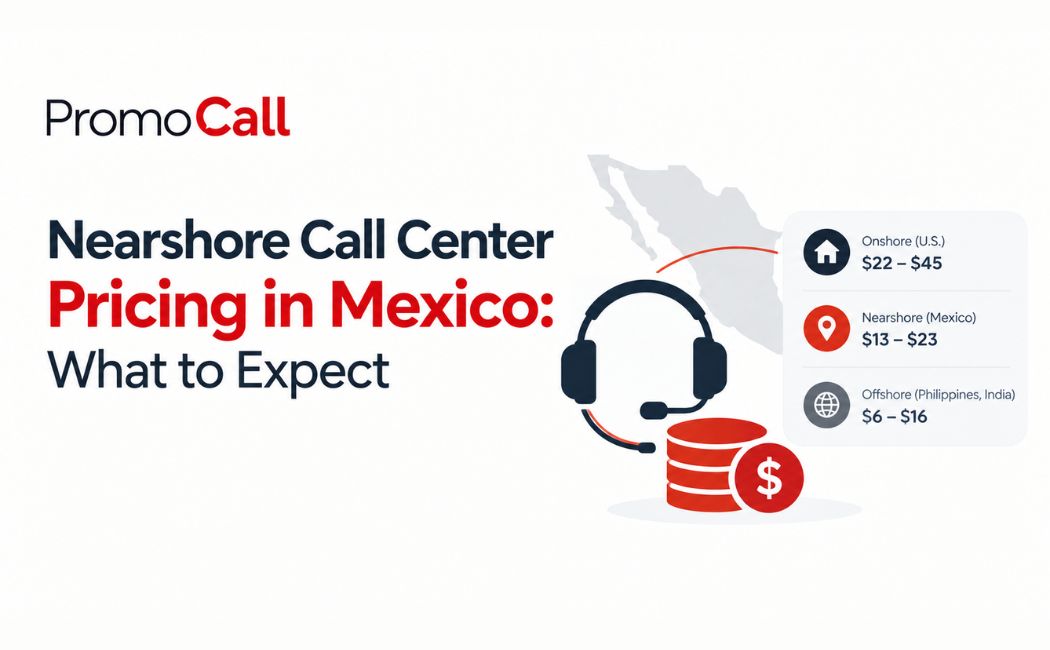
A quote that looks cheap on paper can hide real costs in setup fees, technology licensing, or management overhead billed separately. Always compare fully loaded rates, not headline hourly numbers. For typical pricing ranges and what drives them, see our nearshore call center pricing guide.
5. Scalability and Contract Flexibility
Your support needs will change — ask specifically how a provider handles volume increases or decreases mid-contract, and whether that requires a full renegotiation. A provider who can’t answer this clearly is signaling rigidity you’ll discover the hard way during your first busy season.
6. Reporting and Communication
The best providers give you real visibility into performance without you having to request it manually — call volume, resolution times, CSAT, and channel-specific breakdowns on a predictable cadence. Vague answers about reporting usually mean the underlying systems aren’t as mature as the sales pitch suggested.
Red Flags Worth Taking Seriously
- Vague answers about the actual physical location of agents
- Certifications claimed but no documentation offered on request
- Pricing that can’t be explained in terms of what’s included
- No clear answer on how staffing scales up or down
- Reluctance to provide references or connect you with existing clients
Frequently Asked Questions
How long should the vetting process take before choosing a nearshore partner?
It varies by team size and complexity, but rushing past compliance verification or reference checks to save a few weeks is rarely worth the risk — these are the hardest things to fix after signing.
Should I prioritize cost or compliance when evaluating providers?
Compliance should never be traded for cost if you handle sensitive data — a cheaper provider that can’t produce real certification documentation represents a liability, not a savings.
Is it reasonable to ask to visit a provider’s facility before signing?
Yes, and a provider that’s genuinely transparent about their operations should welcome this, especially for nearshore locations where an in-person visit is realistic.