If you’re outsourcing customer service for a U.S. business, the cheapest seat on the price sheet is rarely the cheapest seat in practice. Offshore hubs in Asia win on hourly rate. Nearshore centers in Mexico win on time zone, Spanish and how easily your team can work with theirs.
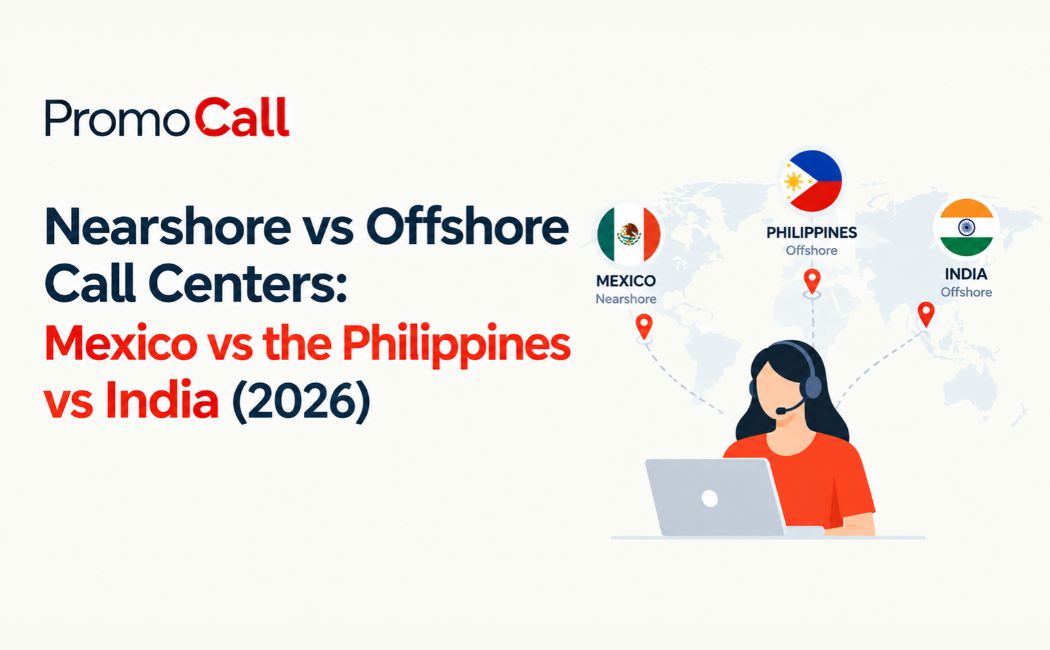
This guide compares the three locations U.S. buyers ask about most: Mexico, the Philippines and India. We’ll look at cost, hours, language, culture, oversight and compliance, then show which model fits which kind of business.
The short answer:
- India has the lowest labor cost and is strong for back-office and technical work.
- The Philippines is the strongest offshore option for high-volume English voice support.
- Mexico costs more per hour than Asia, but works your hours, speaks Spanish natively and is a short flight (or drive) away.
If your customers call during U.S. business hours, or a meaningful share of them speak Spanish, a nearshore call center usually delivers more value per dollar.
Mexico vs the Philippines vs India at a glance
| Factor | Mexico (nearshore) | Philippines (offshore) | India (offshore) |
|---|---|---|---|
| Typical agent rate (fully loaded, 2026) | $13–$23/hr | $7–$16/hr | $5–$14/hr |
| Time difference vs U.S. Eastern | 0–3 hrs (Tijuana is on Pacific Time) | 12–13 hrs ahead | 9.5–10.5 hrs ahead |
| Agents on your daytime shift | Yes, normal day shift | Night shift locally | Night shift locally |
| Spanish | Native | Limited | Rare |
| English (national average, EF EPI 2025) | Very low (440); screened bilingual hires only | High (569) | Low (484) |
| Flight from the U.S. | Hours; Tijuana borders San Diego | 14+ hrs | 15+ hrs |
| Best fit | Real-time, bilingual, customer-facing work | High-volume English voice support | Back-office, technical, cost-first work |
Rates are published 2026 industry ranges, not quotes. Your price depends on volume, hours, skills and channel mix. Sources are listed at the end of this post.
Cost: offshore is cheaper per hour, but compare the whole bill
On hourly rate alone, Asia wins. Published 2026 benchmarks put offshore agents in India and the Philippines at roughly $5–$16 per hour, while Mexico runs about $13–$23 with a median near $17. A U.S. in-house agent, once you add payroll taxes, benefits, management, software and office space, typically costs $30–$45 per hour.
Here’s what that looks like for a 10-agent team working 168 hours a month each:
| Model | Example rate | Monthly cost (1,680 hrs) |
|---|---|---|
| U.S. in-house, fully loaded | $35/hr | $58,800 |
| Nearshore, Mexico | $17/hr | $28,560 |
| Offshore, Philippines | $11/hr | $18,480 |
On paper, offshore saves another ~$10,000 a month over Mexico. In practice, part of that gap closes once you count the costs that don’t show up on the rate card:
- Overnight operations. Asian agents covering U.S. daytime work night shifts, which brings higher attrition and night premiums in many markets.
- Management overlap. Your supervisors, QA team and trainers end up on late-night or early-morning calls to work with an offshore team.
- Travel. Site visits, onboarding and quarterly reviews in Manila or Bangalore mean long-haul flights. Tijuana is a short drive from San Diego.
- Rework and lost customers. Calls that need a callback, an escalation or a supervisor cost more than the minutes they took. So does a customer who hangs up and buys from a competitor.
The honest takeaway: if your work is simple, high-volume and English-only, offshore can be the lowest total cost. If it involves sales, Spanish speakers, complex questions or real-time coordination with your team, nearshore often wins on cost per resolved call. For a deeper breakdown, see our guide to the true cost of in-house vs outsourced call centers.
Time zones: the advantage you feel every day
Tijuana runs on Pacific Time and follows U.S. daylight saving, so a PromoCall agent’s 9-to-5 is the same as a Los Angeles office’s 9-to-5. That’s at most a three-hour difference from New York.
Manila sits 12–13 hours ahead of U.S. Eastern Time, and India 9.5–10.5 hours ahead. Offshore teams can absolutely cover U.S. hours, but they do it overnight, and your own staff are asleep while the work happens.
This matters most when:
- Calls need a handoff. A hot lead, a billing dispute or a patient question that needs your in-house team gets resolved the same day.
- Things change fast. A price change, a recall or a promo going live can be briefed to agents in a quick afternoon huddle, not an email that waits overnight.
- You want to listen in. Managers can monitor live calls, run side-by-sides and coach during normal working hours.
- You run after-hours support. A nearshore team can still cover evenings and weekends, see our post on 24/7 after-hours call center support.
Language: English quality and the Spanish question
English. The Philippines has a real edge here. English is an official language there, and it scored 569 in the EF English Proficiency Index 2025, ranking 28th worldwide. India scored 484 and Mexico 440.
But national averages measure the general population, not the people a call center hires. What matters is the agent on your line. Tijuana is a border city with a large cross-border workforce, and many agents grew up, studied or worked in the United States. That’s the pool PromoCall hires from, and every agent is screened for native-level English before they take a call.
Whichever location you choose, don’t rely on a country ranking. Ask any vendor for recorded calls, and run live test calls with the actual agents proposed for your account.
Spanish. This is where Mexico has no real competition. Around 42 million people in the U.S. speak Spanish at home, according to Census Bureau survey data. If you sell insurance, loans, auto, healthcare or home services, a large share of your callers may prefer Spanish.
Mexican agents speak it natively, with the vocabulary and accent most U.S. Hispanic customers know. Offshore Asian centers rarely offer Spanish at scale. If you need both languages, our bilingual call center services let the same team switch languages mid-call, with no transfer.
Culture, oversight and data security
Cultural fit. Customer service is more than the script. It’s small talk, humor, sports, holidays and knowing what a U.S. customer means when they say they’re “just looking.” Agents in a border city like Tijuana live alongside U.S. culture every day, which shows up in how naturally they handle those moments. Read more about bilingual culture between Tijuana and San Diego.
Oversight. Visiting an offshore center means two days of travel each way. Visiting Tijuana from San Diego takes about as long as a long commute. That makes it practical to sit in on training, meet your agents and fix problems in person, not just on video calls.
Data security and compliance. Any location can be secure, and any location can be sloppy. Judge the vendor, not the country. Before signing, ask for:
- A current SOC 2 report or equivalent security controls
- PCI DSS compliance if agents take card payments
- A signed Business Associate Agreement (BAA) and HIPAA-compliant processes if agents handle patient data
- Clear data-processing terms in the contract, including which country’s privacy law applies
Our guide to SOC 2, PCI and HIPAA for call center partners explains what each one means in plain terms.
Which model fits your business?
Offshore (Philippines or India) makes sense when:
- Your volume is high and the calls are simple and repetitive
- All your customers speak English
- Most work can wait for the next day, like email, data entry or back-office tasks
- Lowest hourly rate is the top priority and you have managers who can work odd hours
Nearshore (Mexico) wins when:
- Calls happen during U.S. business hours and need answers in real time
- A meaningful share of your callers prefer Spanish
- Agents are selling, qualifying leads or handling sensitive conversations, like finance, healthcare, auto or insurance
- You want your team to visit, train and coach agents without long-haul travel
- You need to ramp quickly and adjust scripts the same day
Many U.S. companies use both: offshore for back-office and overnight email, nearshore for live voice and bilingual support. There’s no rule that says you have to pick one.
Where PromoCall fits
PromoCall is a nearshore call center in Tijuana, Mexico, supporting U.S. companies since 2016. Our bilingual agents handle inbound and outbound calls for businesses in finance, healthcare, automotive, ecommerce and home services, on your hours and in your customers’ language.
What that means for you:
- Savings of up to 60% compared with a fully loaded in-house U.S. team
- Same time zone as the U.S. West Coast, with easy overlap for Central and Eastern teams
- English and Spanish from the same agents, screened for native-level English
- Close enough to visit, just across the border from San Diego
- Flexible models, from a fully managed BPO team to seat leasing for your own staff
Weighing nearshore against offshore? Tell us your call volume, hours and languages, and we’ll put together a side-by-side cost estimate for your exact program. Get a free quote.
Frequently asked questions
What is the difference between a nearshore and an offshore call center?
A nearshore call center is in a nearby country with a similar time zone, like Mexico for U.S. companies. An offshore call center is far away, usually in Asia, with a large time difference, like the Philippines or India.
Is Mexico cheaper than the Philippines for call center outsourcing?
No. Per hour, the Philippines and India are cheaper. Mexico typically runs about $13–$23 per agent hour versus roughly $5–$16 in Asia. Mexico often closes the gap on total cost through same-hours coverage, native Spanish, lower travel costs and easier management.
How much can a U.S. company save with a nearshore call center?
Compared with a fully loaded in-house U.S. team, nearshore outsourcing in Mexico can save up to around 60%. Actual savings depend on your current costs, hours and the skills you need.
Do Mexican call center agents speak fluent English?
It depends on the vendor’s hiring. Mexico’s national English average is low, but border-city centers like Tijuana hire from a bilingual, cross-border workforce and screen for English. Always ask for call recordings and run test calls.
Which is better for Spanish-speaking customers?
Mexico. Spanish is the native language, and agents understand the vocabulary and culture of most U.S. Hispanic customers. Offshore Asian centers rarely offer Spanish at scale.
Can I use both nearshore and offshore?
Yes. Many companies keep back-office and overnight email offshore while running live voice, sales and bilingual support nearshore.